
Across Iowa, historic landmarks that once echoed with church hymns, classroom lessons, and military commands are experiencing an impactful second act. Rather than facing demolition or remaining shuttered, aging properties throughout the state are being systematically reimagined as affordable residential housing. This emerging wave of adaptive reuse is breathing fresh life into long-neglected architecture while directly confronting regional shortages of accessible living options.
Notable restoration projects span several communities and architectural eras. Among the prominent sites undergoing conversion are a 102-year-old Catholic church and school complex in Waterloo, a nearly 130-year-old former U.S. Army post in Des Moines, and a 69-year-old Lutheran church situated just blocks away from the Iowa State Capitol. While these historic properties originally served vastly distinct civic, spiritual, and military functions, they now share a unified purpose: expanding Iowa's inventory of affordable housing.
The push toward utilizing existing structures comes at a critical time for Iowa's residential landscape. According to records and analysis from the Iowa Finance Authority, the state possesses the eighth-oldest housing stock in the entire country. Official data indicates that the median year of residential construction across Iowa is 1957, underscoring the deep historical roots and advanced age of the state's built environment.
This substantial volume of aging infrastructure presents both unique challenges and significant opportunities for local municipalities. Alongside its older residential neighborhoods, Iowa features a widespread inventory of underutilized, vacant, and aging institutional properties. For community leaders and regional planners, these surplus structures represent valuable square footage that can be creatively revitalized to meet pressing modern community demands.
Rather than relying solely on ground-up new construction, developers and non-profit organizers across Iowa are adopting creative approaches centered on historic preservation. By retrofitting existing walls, frameworks, and structural foundations, project planners can preserve irreplaceable local character while simultaneously engineering cost-effective housing options for populations in need.
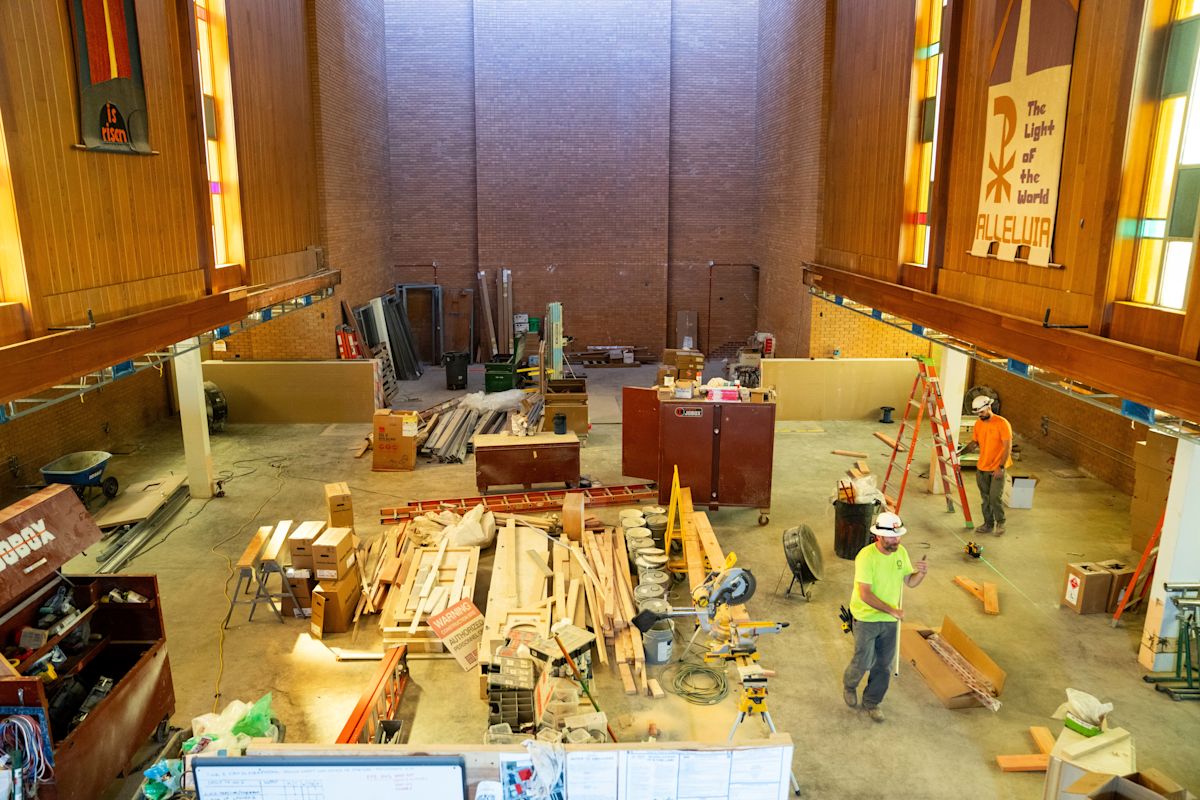
A prime example of this innovative strategy is currently unfolding in Des Moines, where the former Elim Christian Fellowship building—originally constructed 69 years ago as a Lutheran church—is undergoing a comprehensive interior transformation. Located in close proximity to the state Capitol, the property is being completely reconfigured into a dedicated community asset.
The project, known as Stay, is spearheaded by the local organization Starts Right Here under the guidance of its founder, Will Keeps. The initiative focuses on addressing the specific vulnerabilities faced by marginalized young people, pairing secure living arrangements with targeted educational and community support systems.
Through the Stay by Starts Right Here development, the former church facility will offer affordable housing units combined with educational programming specifically tailored for at-risk youth. The integrated model aims to provide stable shelter alongside supportive environments that empower young residents to pursue educational milestones, job stability, and long-term personal independence.
Active construction at the Des Moines site throughout late August 2026 illustrates the extensive progress being made to retrofit the former sanctuary, assembly spaces, and fellowship halls into modern residential suites. Architectural renderings and ongoing building activity reveal how structural frameworks are being systematically transformed into secure, private living quarters for youth.
Similar adaptive efforts are making headway in Waterloo, where a 102-year-old Catholic church and accompanying school building are being rescued from prolonged disuse. By converting century-old educational and religious spaces into functional residential apartments, the development helps preserve neighborhood heritage while expanding local rental affordability.
In another sector of Des Moines, developers have focused on military heritage by rehabilitating a nearly 130-year-old former U.S. Army post. The conversion of these historic military quarters demonstrates the sheer versatility of the state's vintage properties, showing that even specialized government compounds can be repurposed into functional domestic residences.
Housing advocates and preservationists note that repurposing existing historic assets carries distinct advantages over standard ground-up developments. In addition to preserving architectural craftsmanship that is rarely replicated today, adaptive reuse can significantly curb urban decay by keeping prominent neighborhood anchor buildings active and structurally sound.
Furthermore, addressing the statewide need for affordable living arrangements through historic restoration prevents prominent community landmarks from sitting idle or falling into disrepair. By converting unused classrooms, former barracks, and redundant sanctuaries into apartments, developers are keeping historical character intact while delivering functional utility to working families and young people.
As the demand for accessible housing continues across Iowa, the creative repurposing of these century-old and mid-century landmarks provides a viable blueprint for sustainable urban development. By transforming forgotten historical spaces into vibrant community homes, developers and community advocates are proving that the state's architectural past can offer practical solutions for its future.







(0)