
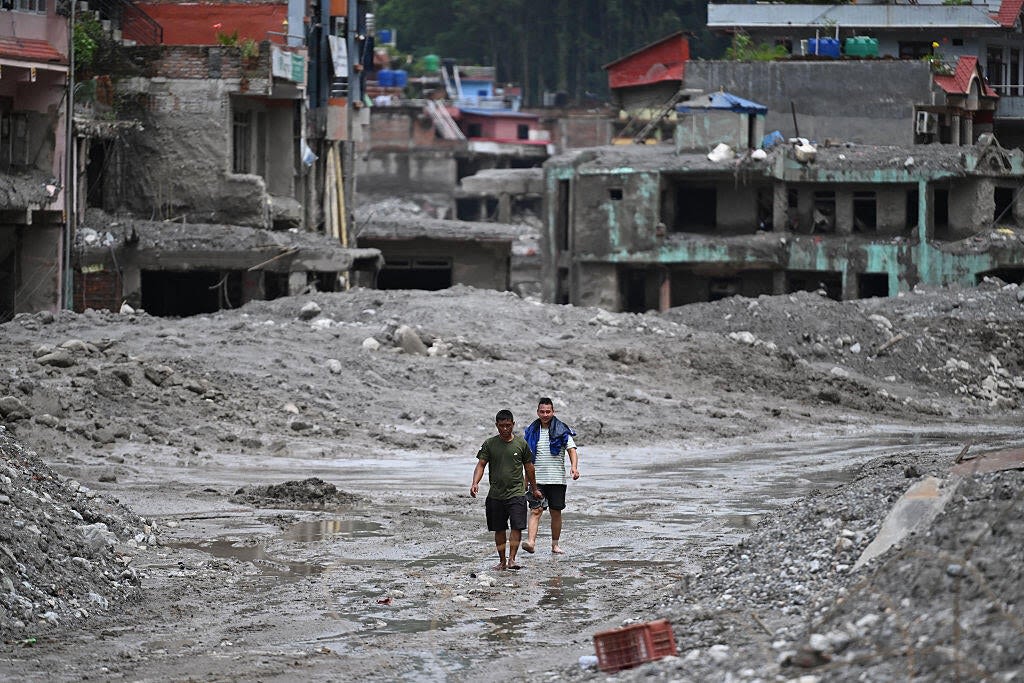
Nepal remains on high alert following a devastating flash flood that has now claimed over 900 lives and left thousands missing. The disaster, which began with a catastrophic glacial collapse in the Himalayas, has caused widespread destruction and has prompted fears of further flooding as the death toll continues to rise.
The flood-affected districts in Nepal are bracing for possible fresh flooding as rescuers work tirelessly to clear a major highway connecting the capital, Kathmandu, to some of the hardest-hit areas. The country's disaster agency reported that the death toll had reached 903 with 4,247 still missing. Across the border, Chinese authorities have reported 16 deaths and 546 missing.
Early Sunday, authorities issued flood warnings to residents' phones after water levels in the Bhotekoshi River surged. Chinese authorities informed their Nepalese counterparts of increased water flow upstream, which has raised concerns about further flooding in the region.
Survivors in flood-affected villages are struggling to cope with the aftermath of the disaster. Govind Shreshta, a resident of a flood-hit village, described the constant alarms and the difficult task of carrying his elderly parents to higher ground during the night. "It's really difficult for me," he said. "I have a 72-year-old father and a 70-year-old mom. I must carry them and I am exhausted."
In the worst-affected region of Dhading, some residents have begun returning to their ruined homes to see what can be salvaged. Amid the destruction, people are seen shoveling sludge-like mud and rubble off balconies and window frames, searching for items they can save from the floodwaters.
The Trishuli Center in the Nuwakot district has become a focal point for flood survivors. Photos show individuals walking through mud and debris, searching for anything that can be saved from their homes. One man managed to find his chickens alive and tied them up to take them to safety.
The damage extends beyond the immediate flood zone, with a key power plant in the area severely damaged by the floods. Workers began inspecting the facilities on Sunday to survey the extent of the destruction. The plant serves over 20,000 people across four districts, and its shutdown could have significant implications for the affected communities.
The U.S. State Department has reported that there are currently 85 Americans unaccounted for in Nepal, with nine having been safely evacuated. Tommy Pigott, a spokesperson for the State Department, said that they are in direct communication with the Americans to assess their needs and are coordinating with the Nepalese government to provide assistance.
The missing also include hundreds of people from over a dozen countries who were in the region to work, visit the mountains, or make a pilgrimage to a sacred peak. On Sunday, Chinese state media reported that 261 foreigners were missing in Tibet, including over a hundred Nepalis and others from around the world.
The flash floods, which began after a glacial collapse in the Himalayan region, have been described as a tragic consequence of climate change. Scientists who studied satellite images said that a magnitude 5.2 rockfall, triggered by the collapse, caused the subsequent flooding. Nepal's foreign minister has called for a global response to climate change, saying that the country is bearing a disproportionate share of its impact.
As Nepal grapples with the aftermath of the disaster, the world watches and hopes for a swift recovery and the safety of those still missing.


(0)