
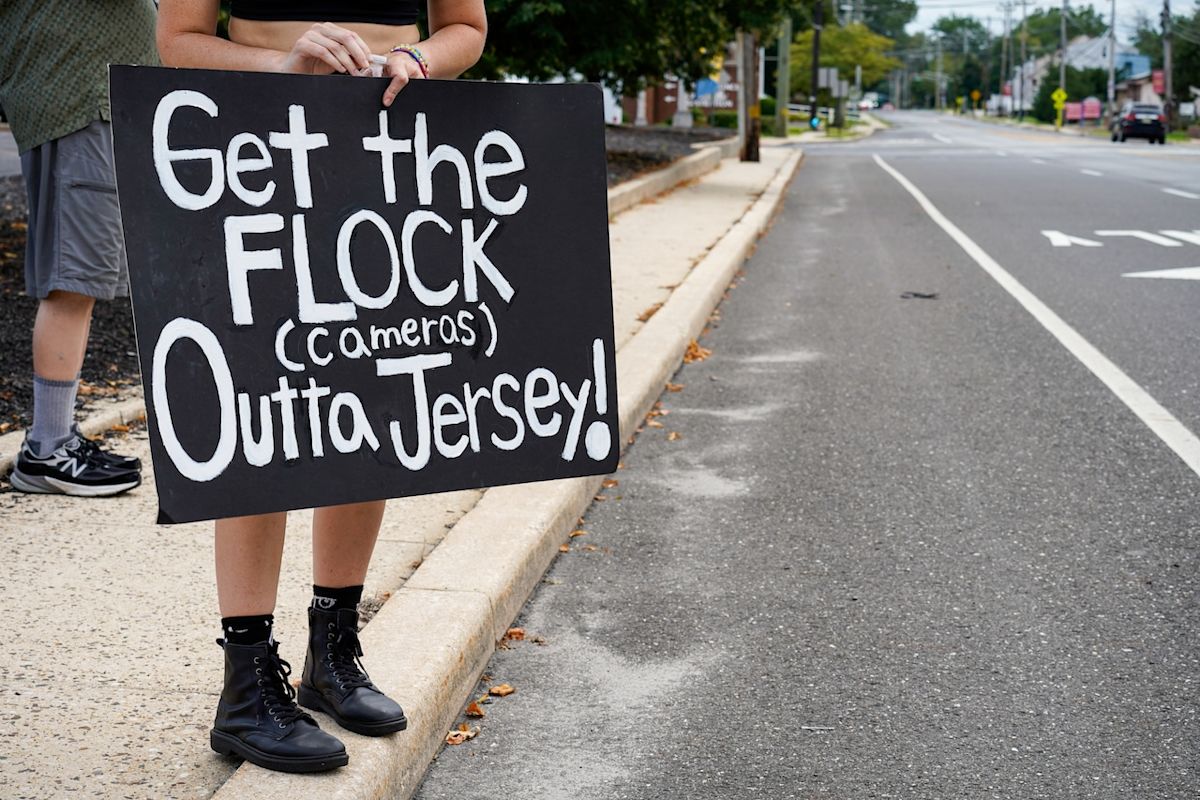
Lawmakers in Trenton are weighing sweeping new legislation that would dismantle private automated license plate reader networks across New Jersey and enact tight restrictions on government surveillance. Under the proposed measure, public agencies would face strict boundaries on how vehicle-tracking technology is deployed, including a requirement to erase the vast majority of captured license plate records within 48 hours.
The bill, formally introduced as Assembly Bill 5483 by Democratic Assemblyman David Bailey Jr. of Salem County, targets automated license plate readers, widely referred to by the prominent brand name Flock. These camera systems utilize artificial intelligence to scan moving traffic, cataloging registration numbers alongside the make, model, and color of passing automobiles into centralized, searchable archives.
Assemblyman Bailey expressed profound alarm over the unchecked expansion of this surveillance infrastructure, warning that the technology threatens the fundamental privacy rights of everyday New Jersey residents. He emphasized that while police agencies have valid reasons to utilize technological tools to combat crime, state law cannot permit artificial intelligence systems to track the routine travel of ordinary citizens or warehouse their location history indefinitely without oversight.
If enacted, the bill would institute an outright prohibition against private citizens and commercial entities operating automated license plate readers. With the exception of vendors authorized to manufacture and install the hardware, private operators would be compelled to dismantle existing camera setups and purge all stored surveillance logs. The state Attorney General would be granted explicit statutory authority to file civil lawsuits against noncompliant businesses or individuals.
The legislation also sharply curtails the scope of permissible camera use by civilian public agencies. State entities would be barred from deploying the systems for general monitoring, confining their operation solely to electronic toll collection, parking facility administration, and securing authorized entry points at sensitive government installations.
Municipal police departments and the New Jersey State Police would operate under a distinct set of operational rules tied directly to official "be on the lookout" notices. Officers would be restricted to using license plate cameras to detect stolen vehicles, severe crimes, missing person alerts, uninsured or unregistered motor vehicles, and state inspection infractions.
To safeguard civil liberties, the statute incorporates explicit anti-bias provisions. Law enforcement agencies would be legally prohibited from placing or orienting surveillance cameras to monitor specific neighborhoods or communities based on race, national origin, religious affiliation, disability status, or other protected characteristics.
The most transformative element of the proposal centers on the state's data storage timeline. New Jersey currently maintains one of the longest automated license plate data retention periods in the United States, keeping vehicle movement records on file for up to three years. In contrast, many jurisdictions across the country retain information for 30 days or fewer, and some states purge non-matching vehicle scans in as little as five minutes.
Under Bailey’s bill, state and local authorities would be required to permanently and automatically purge collected scans within two days. Retaining data beyond that 48-hour threshold would be permitted only if the information is tied to an ongoing criminal investigation, authorized by a formal court order, or associated with a flagged vehicle linked to a major offense, theft, or registration violation.
Interstate and federal data access would likewise face rigorous new legal barriers. Under the proposed framework, New Jersey agencies could not share license plate logs with out-of-state police departments or federal law enforcement bodies without first securing a judicial warrant signed off by the state Attorney General. This would alter current operational practices, which allow select federal partners and neighboring state agencies to query New Jersey's databases directly.
Commercial camera vendors would also be subject to strict statutory boundaries, prohibiting them from monetizing, selling, or transferring captured motorist data to third parties. Furthermore, all participating public agencies would be subject to mandatory annual audits and public reporting guidelines to ensure adherence to state surveillance limits.
The legislative push follows extensive examination of vehicle tracking practices across the state. Official audit figures reveal that 523 of the approximately 530 police departments operating in New Jersey currently employ automated license plate recognition technology. Furthermore, vendor data confirms that at least 82 law enforcement agencies spanning all 21 counties hold active contracts with Flock Safety.
Growing public awareness of this vast digital dragnet has sparked organized pushback at the municipal level. In Berlin Township, more than two dozen demonstrators mobilized outside a local Home Depot in an event coordinated by the advocacy group DeFlock South Jersey, featuring an activist dressed as a mascot named "Flocky." Organizer Adam Sheridan noted that the demonstration was designed to alert community members to the rapid spread of regional surveillance networks.
Similar community resistance surfaced in Franklin Township, where an overflowing crowd attended a local council meeting to voice strong opposition to camera installations, backed by a community petition that garnered more than 800 signatures demanding an end to pervasive vehicular tracking.
Bailey’s proposal joins a broader slate of legislative efforts currently circulating in the state capital. Passaic County Democratic Senator Benjie Wimberly has put forward a bill that would lower data retention to two years and establish criminal penalties for improper data access, while Middlesex County Democratic Senator Linda Greenstein has introduced a measure to prevent state camera data from being shared with out-of-state entities investigating reproductive healthcare and abortion cases. Cumberland County Republican Senator Michael Testa has also signaled plans to introduce guardrail legislation, reflecting bipartisan interest in establishing clear regulatory boundaries for surveillance technology.






(0)