
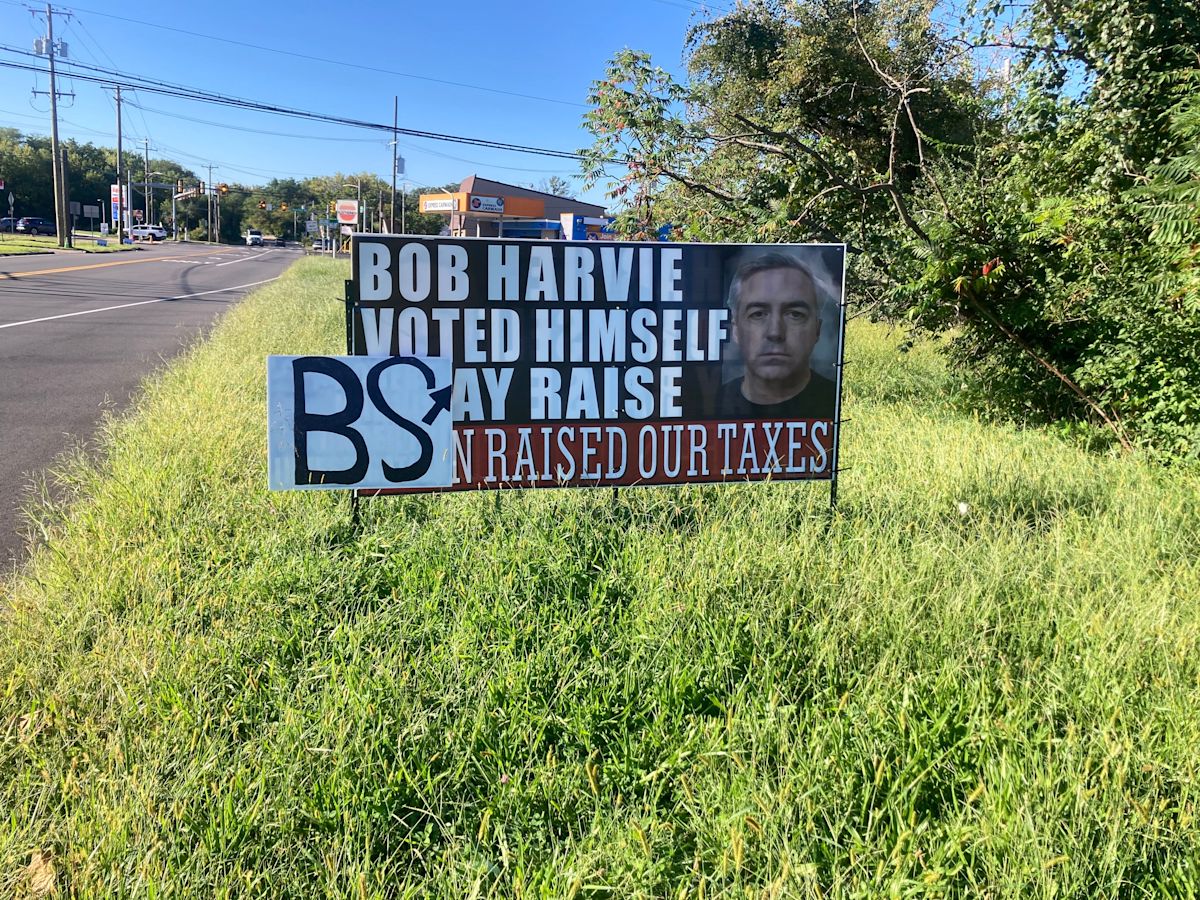
Middletown Township is preparing to implement major revisions to its local temporary sign regulations, introducing strict new guidelines alongside potential fines of up to $500 per day for non-compliant displays. The policy overhaul touches upon virtually every form of temporary signage posted across the community, with political advertisements expected to experience the most noticeable impact.
The Middletown Board of Supervisors moved the regulatory updates forward by unanimously voting to advertise the proposed ordinance. This municipal action is intended to bring local community standards into direct compliance with binding federal judicial precedent, which mandates that local governments across the Commonwealth of Pennsylvania must regulate all temporary public signs equally, without evaluating or favoring the underlying message.
The legal impetus for Middletown’s policy revision originates from a significant May 2024 decision issued by the U.S. Third District Court. In that ruling, federal judges evaluated an ordinance established in Camp Hill Borough and concluded that the municipal government had unlawfully created preferential rules that favored commercial marketing displays and residential real estate signs over political messaging and personal viewpoints.
The court determined that Camp Hill had infringed upon constitutional free speech protections guaranteed under the First Amendment by capping personal expression displays at just two signs per parcel. The judicial panel criticized the borough’s regulatory framework as a confusing and disjointed set of standards that penalized political discourse while simultaneously leaving commercial advertisements and holiday notices uninhibited.
To adhere to the federal mandate of absolute content neutrality, Middletown’s newly drafted ordinance will apply identical standards to every form of temporary display. Advertisements for residential services such as power-washing, notices for youth sports registrations like baseball sign-ups, commercial solicitations to hang seasonal holiday lighting, and standard property real estate markers will all be subject to the same oversight and legal scrutiny.
Under the new regulatory structure, election-related displays will face specific scheduling limitations. Political campaign signs will no longer be permitted to appear on properties more than 30 days prior to a scheduled election, and property owners or campaign organizers must ensure all such materials are fully removed within 10 days after voting concludes.
In addition to timing restrictions, the proposed measure establishes an outright prohibition against placing any temporary sign within a public township right-of-way, regardless of the message or purpose behind the display. These protected rights-of-way commonly extend alongside heavily traveled community thoroughfares and major transportation arteries.
A similar prohibition governing state-controlled rights-of-way managed by the Pennsylvania Department of Transportation has existed for an extended period along state roadways, including Bristol-Oxford Valley Road in Levittown. However, local officials noted that enforcement of state-level roadside display bans has historically been infrequent.
Township Solicitor Jim Esposito addressed the logistical realities of enforcing the expanded rules across Middletown. With a local population approaching 50,000 residents, the municipality stands as one of the largest communities in Bucks County, making dedicated roving enforcement patrols along every roadside right-of-way practically unfeasible.
Rather than maintaining a specialized enforcement division to search for non-compliant postings, the township plans to leverage existing public works personnel. Municipal road crews carrying out their standard maintenance assignments across the township will be instructed to pull down and dispose of illicit signs whenever they encounter them within the municipal right-of-way.
Township officials emphasized that enforcement actions will also be heavily driven by community input and formal citizen reports. Whenever the municipal government receives a notification regarding an unauthorized or improperly situated sign within the public thoroughfare, township staff will take the necessary steps to remove the offending display.
The financial penalty structure established in the ordinance allows local district justices to assess monetary fines reaching $500 per day for each separate infraction. However, township leadership noted that local authorities intend to exercise discretion and show initial leniency to individuals or organizations violating the rules for the first time.
According to Solicitor Esposito, persistent violators who disregard warnings are the primary targets for substantial legal penalties. If a non-compliant property owner or advertiser is instructed to remove an unauthorized sign and deliberately fails to do so, township officials intend to pursue formal proceedings before a district justice to secure the maximum fine.
For temporary markers placed entirely on private property—including residential front yards advertising a home for sale or conveying personal opinions—the township plans to adopt a less intrusive posture, especially when displays do not generate neighborhood grievances or traffic safety concerns.
Nonetheless, even permissible residential displays on private land must strictly conform to uniform dimensional boundaries outlined in the measure. Individual signs may not exceed an area of 12 square feet, and the cumulative surface area of all temporary signs positioned on a single parcel cannot surpass a total maximum of 24 square feet.
Through these comprehensive updates, Middletown aims to balance neighborhood aesthetics, public safety, and statutory obligations, ensuring that local sign administration aligns fully with constitutional mandates while treating all forms of community expression on an equal footing.






(0)