
A major emergency search and rescue operation is underway across the Java Sea after an Indonesian passenger vessel overturned in severe weather conditions on Sunday, leaving approximately 130 people missing. Emergency response teams have managed to pull at least 107 survivors from the water, while maritime searchers have recovered the bodies of six victims as rescue vessels and aircraft expand their operations around the capsized vessel's last recorded coordinates.
The stricken vessel, identified as the Virgo Transport 8, was transporting more than 240 passengers and crew members when disaster struck. The ferry was traveling on a routine domestic route connecting the major port city of Surabaya in East Java with the city of Banjarmasin, located in South Kalimantan province on Borneo Island.
According to emergency management authorities, the journey was severely disrupted by deteriorating weather that created hazardous conditions along the vessel's maritime corridor. The ship's captain had contacted authorities to report turbulent waters, with wave heights reaching up to 10 feet in the Java Sea, shortly before the situation deteriorated drastically.
The captain transmitted an urgent distress call indicating that the ferry was listing dangerously amid the rough swell. Soon after the communication, local maritime authorities received critical intelligence confirming that the passenger vessel had fully overturned in the turbulent waters.
The search and rescue office in Banjarmasin reported that formal emergency notification was received approximately two hours after all radio and tracking contact with the Virgo Transport 8 ceased around 2 a.m. on Sunday. Head of the Banjarmasin Search and Rescue Office, I Putu Sudayana, explained that rescue crews were immediately mobilized and directed toward the vessel's last reported maritime coordinates once the alert was verified.
By Sunday afternoon, emergency authorities had significantly escalated the maritime response. The operation deployed an extensive search contingent supported by eight major marine vessels—including four Indonesian Navy ships—alongside two helicopters tasked with conducting low-altitude visual sweeps across the search grid.
Initial navigational data confirmed that the ferry’s last known position was situated roughly 92 miles away from the port of Banjarmasin. Aerial reconnaissance teams surveying the scene reported that the vessel had not completely slipped beneath the surface, but was instead floating upside down in the open water.
Indonesian Transportation Minister Dudy Purwagandhi confirmed to reporters on Sunday that aerial observation flights showed the overturned ferry remained buoyant. Minister Purwagandhi noted that search teams have concentrated their most intensive diving and surface operations directly in the waters surrounding the overturned hull in hopes of locating additional survivors.
According to official ship manifests, the Virgo Transport 8 was carrying a total of 243 people, comprising 213 passengers and 30 crew members. The manifest also noted that the vessel was transporting cargo that included 89 motor vehicles. However, maritime authorities noted that official passenger documentation in the region can frequently differ from the actual number of individuals present on board.
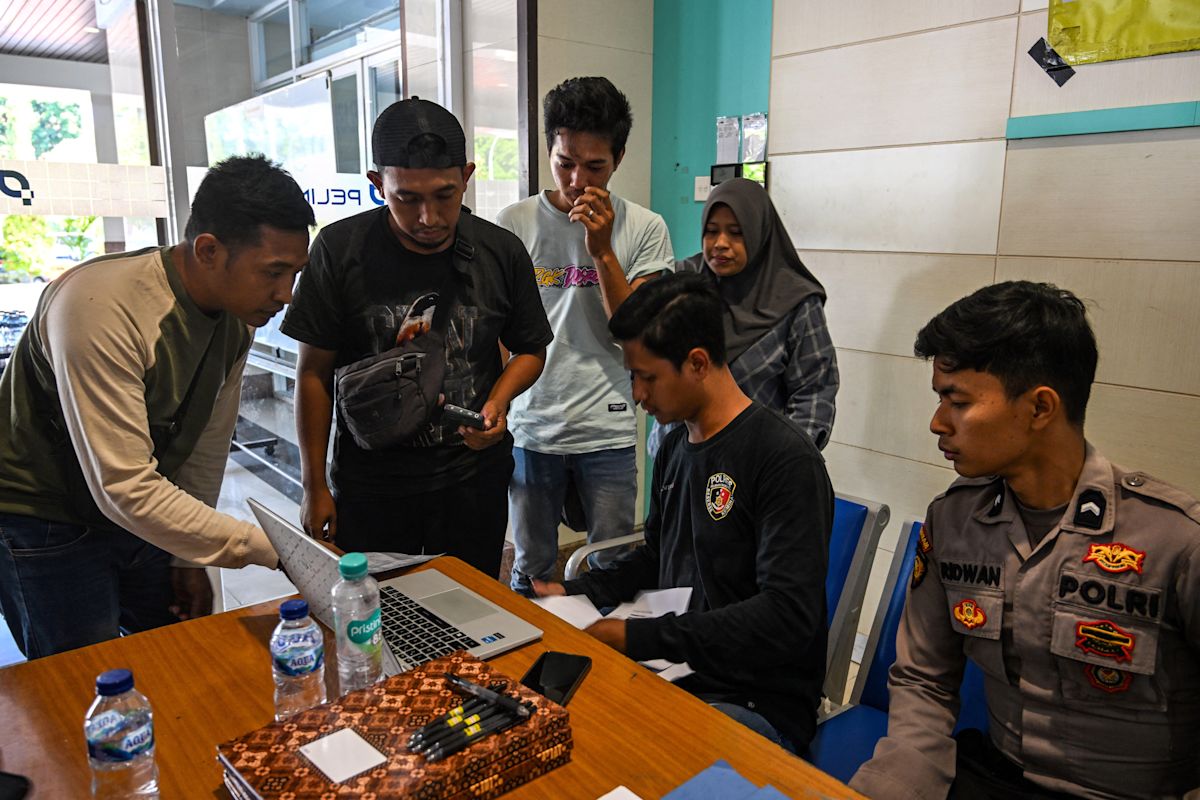
The unfolding disaster prompted hundreds of deeply distressed family members to assemble at a dedicated emergency command post established at Trisakti Port in Banjarmasin. Relatives gathered in large numbers throughout the day, anxiously scanning bulletin boards, examining passenger logs, and awaiting official updates regarding their missing loved ones.
The tense atmosphere at the port command center was marked by shifting emotions as survivor identities were gradually confirmed. Bunga, a relative who traveled to the port to seek information, described the initial panic of discovering her family member's presence on the manifest, followed by profound relief upon learning from rescue officials that her uncle had been successfully pulled from the sea alive.
Local law enforcement and port officials worked continuously throughout Sunday to process inquiries from grieving families, such as Ela Nur Atika, who sought updates regarding her husband's status aboard the overturned vessel. Police gathered detailed personal information from relatives at Trisakti Port to aid emergency teams in identifying recovered victims and confirming the safety of those rescued.
The catastrophe highlights the ongoing vulnerabilities inherent to inter-island transportation across Indonesia. As an expansive archipelagic nation comprising more than 17,000 islands, passenger ferries serve as an essential and indispensable lifeline for the movement of millions of citizens and commercial goods between major population centers.
Despite their critical necessity, maritime accidents remain a recurring hazard throughout Indonesian waterways. Industry observers and officials frequently point to poor weather conditions, shifting marine manifests, and lax safety enforcement as systemic factors that contribute to recurring transportation tragedies in the region's busy shipping lanes.





(0)