
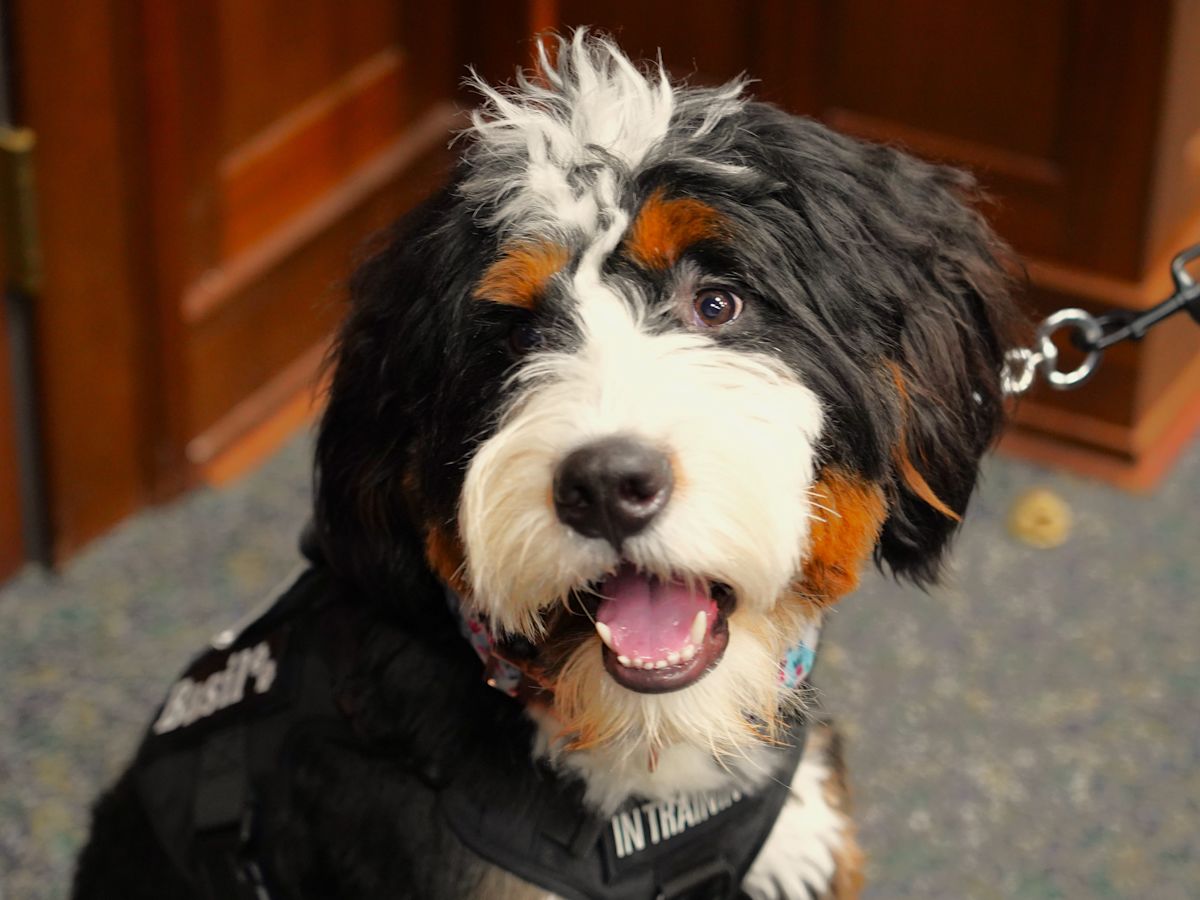
Receiving a jury summons in the mail is often met with dread, but community members called to grand jury duty in Hamilton County encounter an unexpected presence in the justice system: Basil, a dedicated therapy dog. Managed by the Hamilton County Prosecutor's Office, the four-legged staff member offers comfort and reassurance within an environment that is frequently defined by stress, difficult testimony, and intensive legal deliberations.
Instantly recognized by his mop of white fur, perpetually grinning expression, and small vest marked with his name, Basil frequently pads through the prosecutor’s office alongside detectives and assistant prosecutors. His primary responsibilities include providing emotional grounding for crime victims and their loved ones, as well as offering support to grand jurors who are tasked with reviewing evidence in distressing and traumatic criminal matters.
Beyond the comforting presence of a therapy dog, serving on a grand jury in Hamilton County offers practical differences from standard courtroom service. Rather than sitting in a public courtroom under the gaze of a gallery, grand jurors complete their service in dedicated administrative meeting spaces. During their typical two-week service period, these citizens also avoid the long, cumbersome security lines that typically form at the entrance of the county courthouse.
The recruitment process begins identically to other civic assignments, pulling prospective participants from driver’s license records and voter registration rolls. However, the daily reality of grand jury work diverges sharply from fictional television courtroom dramas. Grand jurors do not engage in standard trial proceedings, nor do they evaluate a defendant's ultimate guilt or innocence; instead, they serve a distinct investigative and gatekeeping function.
Across the United States, roughly half of all states utilize grand juries to evaluate evidence before formal charges are filed. In Ohio, this screening procedure is specifically applied to serious felony allegations, as well as any misdemeanor charges that are directly connected to a felony case. The process determines whether prosecutors have established sufficient foundation to move forward with a criminal indictment.
The structure of grand jury hearings is decidedly one-sided compared to regular trials. The accused individual is not present in the room, nor is their defense counsel permitted to participate or argue before the panel. Instead, the proceedings focus on the state's initial presentation of facts, though grand jurors retain the authority to directly question police officers and other witnesses who present evidence.
To govern these deliberations, the Ohio Judicial Council outlines a specific standard for jurors to apply. Members must decide whether the presented evidence is sufficiently reliable and credible to conclude that the accused person probably committed the alleged crime. This legal threshold of probability serves as the foundation for establishing probable cause in felony matters.
Panel structure and voting rules are strictly regulated under state procedures. Hamilton County grand juries consist of nine voting members along with alternates, and at least seven jurors must vote in favor of an indictment for a case to proceed to trial. If seven votes are not secured, the matter is dropped—an outcome formally referred to by court officials as a "no bill" or an "ignored" case, though prosecutors retain the right to present the matter again if new evidence surfaces.
The pace of grand jury work in Hamilton County is exceptionally demanding. While smaller Ohio counties convene grand juries infrequently due to lower population numbers, Hamilton County operates two separate panels of nine jurors every weekday, 52 weeks a year, pausing only for specific holidays. During a single two-week term, an individual juror may hear 100 cases or more.
The sheer volume of local criminal matters translates into an extensive overall docket. County Prosecutor Connie Pillich noted that grand jury panels in Hamilton County reviewed more than 5,700 cases over the course of 2025. This unrelenting schedule means jurors must process an enormous breadth of testimony, records, and photographic materials across their service.
The physical setting reflects this decades-long volume of daily legal proceedings. Located inside the prosecutor’s office building on Ninth Street, just a single block away from the main courthouse, the grand jury rooms lack the soaring ceilings and spacious layouts of traditional courtrooms. The compact spaces bear visible marks of constant use, including wood-paneled walls deeply scarred from decades of chair backs rubbing against them day after day.
To make the environment more functional and welcoming, Kate Burroughs, who became the Chief of Grand Juries and Intake in January 2025, took steps to renovate and update the facilities. Enlisting the help of her daughters as volunteers, Burroughs refreshed the rooms, patched up heavily worn seating, and introduced tables into work areas where none had previously existed.
Technology within the grand jury rooms has also seen vital modern upgrades. In earlier years, presenting detectives were often forced to walk around the room displaying photos and video evidence directly from their personal mobile phones. Under recent improvements, high-definition television monitors were installed, allowing all nine panel members to view digital exhibits clearly and simultaneously during presentations.
Before evaluating active criminal cases, jurors undergo foundational legal instruction on their first day of service. Court officials introduce key statutory principles, clarifying the legal definitions of terms such as acting "knowingly" or "recklessly," explaining the parameters of legal "possession," and outlining active Ohio firearm statutes. To help jurors find their footing, the docket on this introductory day is kept intentionally light.
Prosecutor Connie Pillich observed that grand jury proceedings operate with directness and efficiency, noting that the environment lacks the theatrical arguments common to public trials. Instead, jurors methodically examine evidence presented by law enforcement, with drug trafficking and illicit possession offenses making up the largest share of the thousands of cases evaluated each year.








(0)